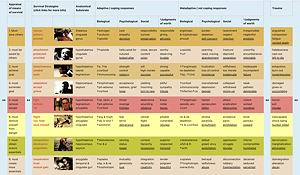
The table below lists specific appraisals which evoke one or other of eight survival strategies. They are respectively Rescue and Attachment, Assertiveness and Adaptation, Fight and Flight, and Competition andCooperation, forming four complementary pairs.
Survival strategies are listed according to their adaptive and maladaptive, biological, psychological and social characteristics. These characteristics may act in concert, though individual characteristics may be emphasised as specific symptoms at different times.
Similarly, the apparently static view of the table belies the dynamism within it, and its relationship to parameter and moral dimensions.
The first line for each psychological and social description of survival strategy responses refers to physical survival, while the second to provision of resources. The third lines (bold and underlined) are combinations of both.
The table lists traumas which may arise from each unsuccessful survival strategy. To the right of the Table (not shown) are interactions of traumas with defences and illnesses.To the left of the Table (not shown) are interactions with the initial traumatic situations.
Adaptive and maladaptive judgments of worth are included to give a sense of survival strategy interactions with other, in this case the moral dimension.
A third dimension (also not shown), the parameters dimension indicates what, where when to whom stress and trauma occur, eg to individuals, families, or nations.
Survival struggles in their three dimensions constitute The Wholist Perspective.